Small transport companies handle a constant flow of paperwork, from consignment notes and delivery receipts to invoices, fuel bills, and vehicle documents. Managing these records manually can consume valuable time, increase administrative costs, and create errors that affect daily operations. But how can smaller businesses manage these documents without investing in complicated systems or hiring additional staff?
[***AI document scanning***](https://globusbilling.com/blog/ai-document-scanning-for-transport-small-fleet-setup/) helps small transport companies digitize paperwork, extract important information automatically, organize records, and reduce manual data entry. By combining technologies such as Optical Character Recognition (OCR) and artificial intelligence, businesses can process documents faster, improve accuracy, and make information easier to access.
Let's explore how this technology simplifies transport document management and supports more efficient business operations.
What Is AI Document Scanning for Small Transport Companies?
AI document scanning is a technology that converts physical or digital documents into searchable, organized records. Unlike basic scanning, which creates an image of a document, AI-powered scanning can recognize printed or handwritten information and extract useful data.
For small transport businesses, this means important details can be captured from documents such as:
Consignment notes: Shipment details, sender information, and delivery destinations.
Proof of Delivery (POD): Delivery dates, receiver details, and signatures.
Freight invoices: Charges, taxes, payment details, and billing information.
Fuel receipts: Fuel expenses, transaction dates, and vehicle-related costs.
Vehicle documents: Registration certificates, insurance records, and permits.
Maintenance bills: Repair costs, service dates, and vehicle information.
Instead of manually entering information from every document, employees can use AI-powered tools to extract and organize relevant data.
How Does AI Document Scanning Help Manage Transport Paperwork?
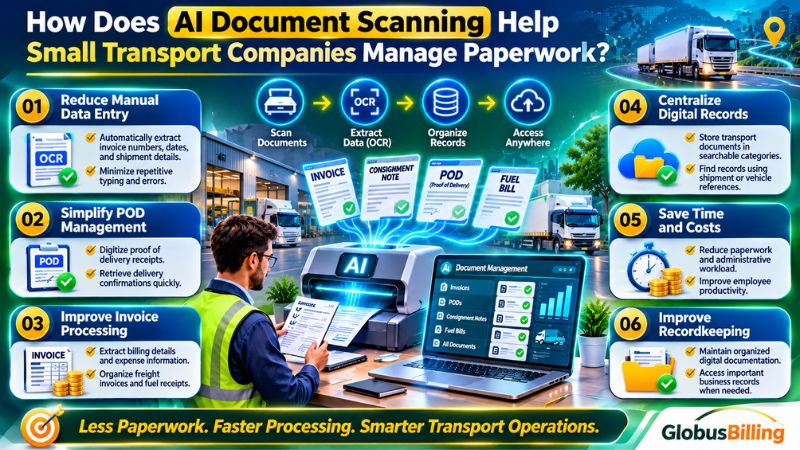
AI document scanning addresses common paperwork challenges by automating repetitive administrative tasks. Here are six practical ways it helps small transport companies.
1. Reduces Manual Data Entry
Manually entering information from invoices, delivery receipts, and transport documents takes time and increases the possibility of typing mistakes.
AI-powered OCR identifies text from scanned documents and converts it into digital information. The system can capture details such as invoice numbers, dates, vehicle numbers, customer names, and shipment references.
This helps businesses:
Reduce repetitive typing.
Minimize data-entry mistakes.
Process multiple documents more efficiently.
Give employees more time for operational tasks.
2. Simplifies Proof of Delivery Management
Proof of Delivery documents are essential for confirming that shipments have reached their destinations. However, collecting and organizing physical POD receipts can become difficult when drivers handle multiple deliveries.
AI scanning allows transport companies to digitize POD documents and extract important information, including delivery dates, receiver names, and shipment references.
Digital POD records make it easier to:
Retrieve delivery confirmation when customers request it.
Verify completed shipments.
Resolve delivery-related disputes.
Maintain organized delivery records.
3. Improves Invoice Processing and Expense Tracking
Small transport companies manage several expenses, including fuel purchases, vehicle repairs, toll charges, and freight payments. Tracking these expenses manually can make financial management challenging.
AI document scanning can extract invoice numbers, supplier details, tax amounts, totals, and payment dates from scanned bills.
This information can support better financial recordkeeping by helping businesses:
Organize incoming invoices.
Track operational expenses.
Reduce errors during invoice entry.
Retrieve billing information quickly.
Prepare records for accounting and reconciliation.
4. Organizes Documents in a Centralized Digital System
Paper documents stored across offices, vehicles, and filing cabinets can be difficult to locate. Important records may also become damaged, misplaced, or duplicated.
AI-powered document management helps convert scattered paperwork into searchable digital records. Documents can be categorized according to type, date, customer, vehicle, or shipment reference.
For example, an employee looking for a delivery receipt can search using a shipment number instead of checking multiple physical files.
Centralized storage improves document accessibility and makes everyday administrative work more organized.
5. Saves Time and Reduces Administrative Costs
Small transport companies often operate with limited employees and budgets. Spending several hours sorting, filing, and entering document details can reduce the time available for customer service and transport coordination.
By automating repetitive document-related activities, AI scanning helps businesses use their existing workforce more effectively.
Potential benefits include:
Less time spent on paperwork.
Reduced printing and physical storage requirements.
Faster document retrieval.
Fewer manual processing errors.
More efficient administrative workflows.
The technology can help smaller companies improve productivity without significantly increasing their administrative workload.
6. Supports Better Recordkeeping and Compliance
Transport businesses need to maintain accurate records for financial reporting, vehicle management, customer transactions, and regulatory requirements.
AI scanning helps create organized digital copies of important documents. Businesses can categorize records, maintain searchable archives, and retrieve information when required.
However, companies should also establish appropriate access permissions, backup procedures, and data retention policies to protect sensitive business information.
How Can Small Transport Companies Implement AI Document Scanning?
Adopting AI document scanning for transport for small transport companies does not have to involve a complicated digital transformation project. Businesses can begin with a few essential steps.
Identify frequently used documents: Start with invoices, POD receipts, consignment notes, and fuel bills.
Choose suitable scanning software: Look for OCR capabilities, automated data extraction, document classification, and searchable storage.
Create a consistent scanning process: Establish how employees and drivers should capture and upload documents.
Verify extracted information: Review important details, especially financial figures, dates, and shipment references.
Organize digital records: Use clear naming conventions and categories for easier retrieval.
Train employees: Help staff understand how to scan, review, access, and manage digital documents.
Evaluate performance: Monitor processing time, data accuracy, and administrative efficiency.
Starting with high-volume documents allows businesses to understand the benefits before expanding automation across other workflows.
## **What Should Small Transport Companies Look for in AI Document Scanning Software?**
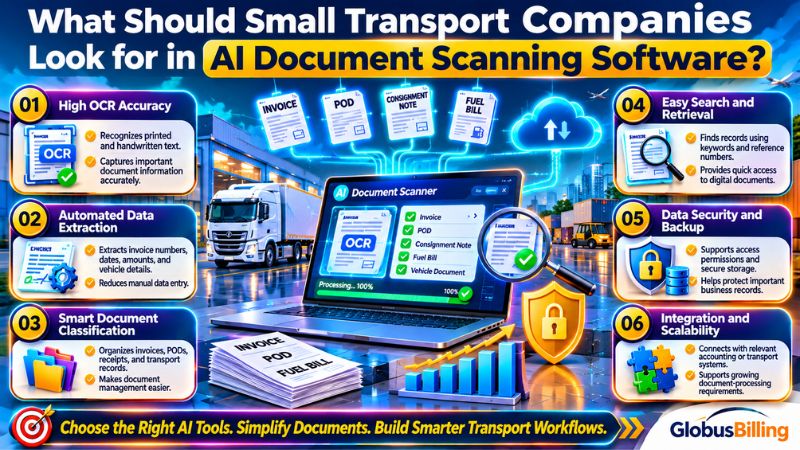
Not every scanning solution offers the same capabilities. Before selecting a platform, businesses should consider:
OCR accuracy: Can it recognize information from different document formats?
Automated data extraction: Can it capture important fields without manual entry?
Document classification: Can it organize invoices, PODs, and other records automatically?
Search functionality: Can employees find documents using relevant keywords or reference numbers?
Integration options: Can it work with existing accounting or transport management systems?
Data security: Does it provide suitable access controls, backups, and protection for business records?
Scalability: Can the system support increasing document volumes as the business grows?
Choosing software based on actual operational requirements helps avoid unnecessary costs and complicated features.
You can also watch:
***https://www.youtube.com/channel/UCQL7v62eFRJ7RGkBbBfidLw***
Conclusion
Managing transport paperwork manually can slow down operations, increase administrative effort, and make important records difficult to retrieve. [***AI-powered document scanning***](https://globusbilling.com/blog/ai-document-scanning-for-transport-small-fleet-setup/) offers small transport companies a practical way to digitize records, automate data extraction, simplify POD management, and improve invoice processing.
By starting with frequently used documents and selecting software that meets their operational needs, smaller businesses can build more organized workflows, improve record accuracy, and spend less time handling paperwork.
Frequently Asked Questions (FAQs)
1. How does AI document scanning work in transport companies?
AI document scanning uses OCR and artificial intelligence to recognize text, extract important information, and organize documents such as invoices, POD receipts, consignment notes, and fuel bills.
2. Can small transport companies afford AI document scanning software?
Yes. Many software providers offer solutions with different pricing plans and features. Small companies can begin with essential scanning and data extraction capabilities and expand as their requirements grow.
3. Which transport documents can AI scanning process?
It can process freight invoices, proof of delivery receipts, consignment notes, fuel bills, vehicle registration documents, insurance records, maintenance invoices, and other business paperwork.
4. Does AI document scanning eliminate manual data entry?
It can significantly reduce manual data entry by extracting information automatically. However, employees may still need to review extracted details and correct errors, especially when documents are unclear or damaged.
5. Is AI document scanning useful for small fleet operators?
Yes. Small fleet operators can use it to organize vehicle records, fuel receipts, maintenance bills, delivery documents, and transportation expenses in a searchable digital system.
6. How can AI scanning improve transport business productivity?
It reduces repetitive paperwork, speeds up document processing, improves information retrieval, and helps employees focus on transport coordination, customer service, and other important activities.